Thursday, April 14, 2016

Niagara St. projects bring life back to old buildings

By Maris Lambie
Bengal News West Reporter
            For decades the gritty, urban environment of Niagara Street  has been the home of multiple old, run down, abandoned buildings with little to look at. The small businesses that are there are spread out, and the busy traffic makes pedestrian travel a bit difficult. 
            However things in the area are beginning to change as the revitalization of the street continues.
            Along with reconstruction of the street, investors hope to revitalize the area by renovating abandoned buildings into mixed-use projects featuring commercial space and high-end apartments.
            There are several buildings being renovated as mix use projects in the neighborhood including 1469 Niagara St., 1502 Niagara St and 960 Busti Ave. These three buildings are all slated for completion this year.
Construction worker Dennis McCarthy at 960 Busti Ave.

            Niagara Street has been considered a gateway to the Buffalo area for quite some time, connecting traffic coming from the Interstate 90 to downtown and acting as a gateway between the U.S. and Canadian borders.
             Major efforts to renovate the area began in 2014 when the $16.3 million Niagara Street Gateway Construction Project first began with the help of local government, the NFTA, neighborhood groups and local businesses and residents.
            “The city is embarking on a whole new reconstruction of Niagara Street. We’re going to see traffic-calming, it’s going to be more pedestrian friendly. There’s going to be green infrastructure as part of the design to help control run offs so that waste water doesn’t end up in the river,” Barbara Rowe, president of Vision Niagara said.


            Vision Niagara is an organization of stakeholders, consisting of Niagara Street residents, businesses, investors and organizations working to improve the quality of the area by creating a mixed use environment.
             “People are looking for opportunity,” said Ellicott Development CEO Bill Paladino.  There were plenty of opportunities here with the old buildings, and these opportunities are scarce in the city.”
            Paladino said historic tax credits can be a driving force toward renovating the city’s old buildings.
             The building at 960 Busti Ave. had been vacant for nearly 20 years until Ellicott Development purchased the building in 2008. Construction on the building had begun in fall 2015 and is slated for completion in June 2016. Preleasing for the apartments has started.
            While one of the original ideas considered was to renovate the building into just apartments, adding commercial space made the cost of the project a bit cheaper.
            “Mixed-use projects were a better alternative,” Paladino said.
            The first two floors of the renovated building will feature commercial space while the other floors will consist of 18 higher end apartments, priced higher than the typical market rate due to the apartment’s high quality features. Ellicott Development is hoping to fill the commercial space with restaurants.
            “These apartments are being completed at a high level of quality,” Tom Fox, development director of Ellicott Development said.”These apartments have imported quartz tile counter tops, designer plumbing fixtures, spacious storage areas, basement parking, and 24-hour security surveillance. It’s a very unique space.”
            The finished apartments will also have views of the Peace Bridge, the Niagara River and Canada, as well as a patio rooftop.
            “It’s comparable to what is being done in other areas, although our prices are a little lower than some of them,” Paladino said. “It can be affordable and we hope that entices people to come.”
            Those investing in apartments and other renovations on Niagara Street believe that the new mix use spaces will bring a positive change to the neighborhood by encouraging more businesses to open up.
            “It will definitely help drive more services.  When people live here they will be looking for places to get a bite to eat, to pick up a cup of coffee, to buy groceries. We’ll see more of that in the area. It will make it a more fun and attractive place to live,” Rowe said, “I don’t know if it will ever be like the Elmwood village, which is kind of cute, this will always be urban, but I think we’ll see a lot more foot traffic out here and less of the speedway that we have now.”

Wednesday, April 13, 2016

Youth impress at Side-by-Side Concert

By Annaliza Guard and Madison Marquardt
Bengal News West Reporters   

         The softness of the violin strings, meet the smoothness of the clarinet as the deep hollow strumming of the cello strings join in.  The music hall fills with the rising sounds of a full orchestra, not a note out of place. 
            On Wednesday April 6, some of Buffalo’s most talented musicians harmonized in the great acoustics of Kleinhans Music Hall, performing classical pieces, as well as some modern ones.  More than half of these decorated musicians are still in high school.
            The concert was part of the Greater Buffalo Youth Orchestra’s Side-by-Side program, which allows students to work with members of the Buffalo Philharmonic Orchestra.
            “The philharmonic assigns a coach for each section,” said GBYO Executive Director Janice Jones.  She has been involved in the GBYO since 2005.
“There is a first violin coach, second violin coach, viola coach, there’s a woodwind coach for that section and a brass coach for that section.”
GBYO students receive one session with their coach, but then participate in 6 rehearsals to prepare for the final performance. 
“The students really enjoy the opportunity to work with their private teachers leading up to it,” said Jones.
“But now they get to sit with someone who does this for a living.  Just sitting on that stage with all that great sound around you, it just motivates you to play harder and better.”
This year the joint orchestra’s performance including demanding classical pieces, but the real showstopper came when the group performed pieces from Star Wars.
            The Side-by-Side program provides students with several unique opportunities.  Not only do students get to work with a professional musician, they get to perform on a stage typically reserved for industry professionals as well.
            “Everyone wants to participate in the Side-by-Side because of the opportunity to perform with the philharmonic onstage at Kleinhans Music Hall,” said Jones.
            The Side-by-Side program is just one part of the GBYO.  The GBYO is made up of students from local middle and high schools.
“We have students from Fredonia to Lewiston,” said Jones.  The GBYO even extends across borders.
“We have students who drive from Fort Erie every Monday night from September to May.”
            Each spring the GBYO holds an audition process, where students from 8th to 12th grade compete for a coveted spot in the youth orchestra.  To be eligible for auditions, students must participate in their school’s music program as well as study privately.
            Students who are accepted into the GBYO must be actively preparing a New York State School Music Association (NYSSMA) level five or six solo.  NYSSMA is the state music grading system, which sets the standard for competitive student musicians.
            Over 7,000 students audition for the 8 All-State performing groups; fewer than 900 are selected to participate annually.  A six is the highest score for a NYSSMA solo.
            One student who made it through the rigorous audition process, and was accepted into the GBYO was City Honors junior Karly Masters.  The viola player auditioned last spring.
            “It was really nerve-wracking,” said Miss Masters.
            “I auditioned three years prior to this as well.  I wasn’t sure if I was going to make it this year, but I finally did.”
            Her mother Kendra’s advice to her daughter was to “relax and do her best.”
            “I knew she would make it,” said Mrs. Masters.
            A stint with the GBYO is a prestigious achievement for any young musician.  Those who wish to continue their music career, like Karly, receive a respected resume, all before graduating high school.
            “I’m working on my college audition piece right now,” said Miss Masters.
            “I’m a junior, so next year I’ll be auditioning for colleges.  I’m thinking about Oberlin, Ithaca, probably Eastman.  I’m narrowing the list down.”


Sunday, April 3, 2016

Traffic helps 500 block of Main St. pop to life

By Julia Waterman 
and Corrinne Wheatley
Bengal News West Reporters

             It may not look like much now but come this summer, the 500 block of Main Street is expected to see a lot more activity.
Manager Tiffany Gagliardo expects more traffic this summer 

A quick view of the 600 block shows more cars and people than it would have seen in past decades. This is the hope for the 500 block as the street is now shared on both blocks by cars and the metro rail.
The use of cars being able to drive through has brought much traffic into shops occupying Main Street. Buffalo Adore, and Scentcerely Yours!, two locally owned boutiques, have benefitted with the opening up of vehicular traffic.
Buffalo Adore is a shop that caters to handmade gifts from local artists. There are two Buffalo Adore shops in Buffalo, one in South Buffalo and the downtown location. The downtown location focuses more on everything to do with Buffalo specifically to cater to tourists.  Owner of Buffalo Adore, Andrea Dacey, has said the traffic that this change has brought to her shop has helped her become successful.
“This couldn’t have even been considered a storefront, but now because of all the traffic I can finally consider it one and it would have been a lot more difficult to survive if Main Street never opened up to cars,” Dacey said.
This change has opened up downtown for people outside the city and it is more convenient now with the parking spaces making all the.
“I see more people using the train, especially people who aren’t used to coming downtown. It’s more crowded now and I think it makes people more comfortable to come down here,” Dacey said.
            Another store that has benefited from the opening up to vehicular traffic is Scentcerely Yours!, which is a small boutique that sells handmade soy candles. The story carried 42 scents, including themed candles, some that go along with the shows that come Shea’s Performing Art Center.
“We are a small, local store and it’s nice seeing all the business we are getting and Main Street opening up to traffic plays a big roll, along with having Shea’s and the restaurant across the street,” said owner Ron Snell.


Another place benefiting from the traffic on Main Street is Expo Market. Expo Market opened in February 2016. It is an upscale food hall offering many different food selections including gourmet sandwiches, a juice and smoothie bar, healthy fast food selection, Italian, and Asian dishes.
Manager Ashley Druar believes the market wouldn’t be as successful if it wasn’t for Main Street opening up to vehicular traffic.
            “There have been a handful of other restaurants that have been at this location, and I think were going to be a great success, and some of that I believe is because we came here as Main Street opened up to cars, people on foot, and the train,” Druar said.
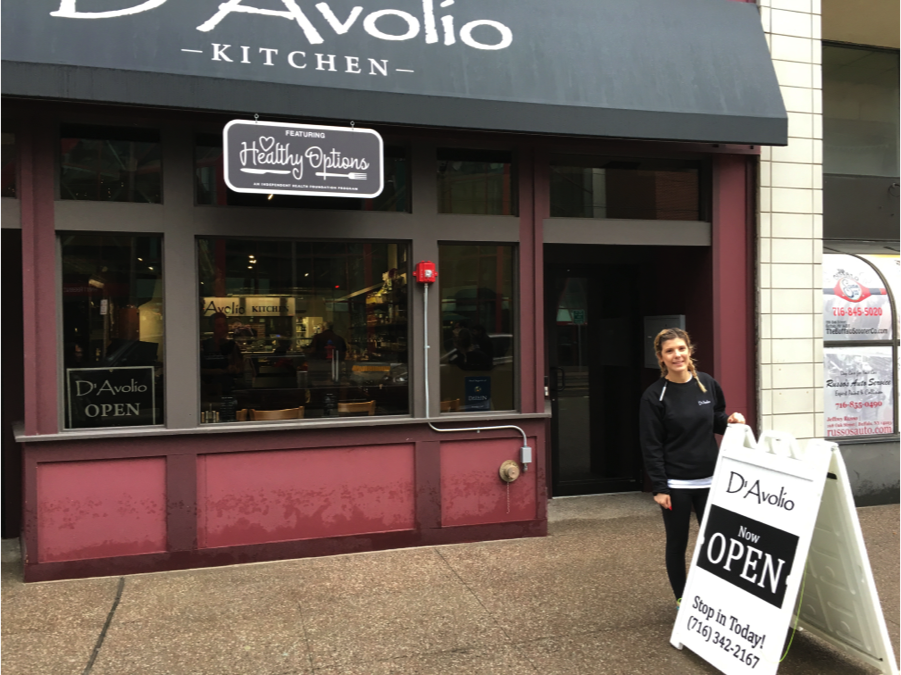
D’Avolio, which opened in August, is among the newest shops on the 500 block. It offers lunch, as well as the sale of olive oils, vinegars, and more.  
“We got lucky opening up just months before the street opened, so we haven’t seen much of an impact on traffic coming in and out. We’re always extremely busy because we are one of the only lunch spots, and everyone down here can easily walk to us. This location makes us and our customers really happy,” Tiffany Gagliardo, store manager of D’Avolio, said.
Joe Incao, Owner of Furnishings, says, “I want this to become a place where people get to walk down from their apartments and be able to come shop.  Down town is on the verge of becoming great again, and if I waited a year, I wouldn’t be able to get this spot, or even maybe afford it.”
            As of right now, a French restaurant, a bar, and a 50’s style ice cream parlor are set to open here within the next few months along with others in the process of this new development of the Main Street strip.


West Side colleges wait for plagiarism loophole to close


By Annaliza Guard and Madison Marquardt
Bengal News West Reporters
            The Internet provides limitless resources to college students across the planet.  Within recent years the World Wide Web has opened an underground black market of students buying and selling term papers, theses and dissertations.
            In a survey conducted by Rutgers University, out of 63,700 undergraduate college students, 7 percent self report to turning in work “done by another.”
            The sale of term papers is not a new phenomenon.  In the 1960s, commercial services began selling term papers to students, sometimes under names like “academic research services.”  In 1981, New York State passed laws to make these sales illegal.
            Until recently the anti-plagiarism laws in New York State contained a loophole that left materials purchased unlawfully over the Internet outside of the current penalties.  Senate bill S2810 seeks to change that.

            The bill extends the current prohibition against the sale of dissertations and term papers to those provided through electronic media such as the Internet.
            Vice President of Student Affairs for Canisius College, Terri Mangione, says that plagiarism is a serious issue.
            “People choosing to make money off of time management issues of students is a problem,” Mangione said.  “If they were to enforce something like this it would be interesting.  If we are mandated to report acts of plagiarism [to state authorities], we will report them.”
            The new bill would remove the ambiguity attached to the current legislation, and assure that students—as well as others who provide unlawful assistance—would be eligible for prosecution.  Violators could be fined up to $1,000.
            Simply adding the phrase “either written or provided through electronic media,” to Section 213b of the Education Law, would remove the loophole that currently prevents state authorities from prosecuting students who illegally obtain materials over the Internet.
            The bill passed unanimously in the senate on Jan. 29.  Sponsors of the bill includes local Sen. Timothy Kennedy, D-Buffalo and Assemblyman Robin Schimminger, D-Kenmore. Last March the bill failed to make it past the assembly..
            Locally, four schools carry policies that reprimand students accused of plagiarism.  Canisius, D’Youville and Medaille colleges and SUNY Buffalo State each have their own definitions as to what constitutes plagiarism. Penalties range from warnings to expulsion.  All four schools also have committees that review cases of students who are accused and the evidence against them. 
            “Our policies for everything are separate and distinct from anything law enforcement would impose,” Mangione said. “If a student is found to be responsible for our policy we will impose our own sanctions. If a student is found responsible for anything outside of Canisius, in terms of law enforcement, then they would move through that process on their own.”
            Mangione also stated that the school has not yet been informed as to how administrators should report violators to authorities or what the new process will entail.

Cultural diversity showing up in West Side restaurants


By Jae Tomlinson and Jamal Richards 
Bengal News West Reporters
            A really hungry person could voyage 6,303 miles across the Pacific Ocean to Japan and enjoy Funazushi for lunch or go 8,299 miles in the other direction to Burma and enjoy Lahpet for dinner.          
There is no longer an ocean that separates people from experiencing the cuisine of other countries. Now people can step through a doorway to one of the many restaurants that fill the West Side with diversity
Diners enjoy Asian cuisine at the West Side Bazaar
As Buffalo continues to grow in immigrant populations one of the most apparent changes to come out of this growth is the diversity and cultural experimentation that has taken over the West Side. The different groups of people moving into the West Side brought with them a taste of their native countries.
            SATO, a Japanese restaurant at 739 Elmwood Ave., is one example of how new cultures have affected the residents of the West Side and their taste in food. SATO specializes in both modern and traditional Japanese cuisine. 


            Satomi and Joshua Smith opened the restaurant in 2014, bringing together her native Japanese culture and their shared world travels and experience in restaurant ownership.
 “We figured that we could bring something authentic to the west side and Buffalo in general,” Joshua Smith said.
A few blocks away at 25 Grant St., another cultural hub of food is packed into a building with enough different kinds of food to take people on an extensive journey.
 “It’s like traveling,” West Side Bazaar Manager Michelle Holler said.
International palates are catered to at the West Side Bazaar
Representing  Ethiopian, Loatian, Thai, Jamaican and Halal cuisines, the West Side Bazaar caters to the traditional taste of the many immigrant and refugee groups on the West Side while encouraging others to join in the adventure. A lot of traditional handmade merchandise is made and put on display. Clothing, wooden sculptures and jewelry grab the eyes of customers as they sift though all the unique clothes and decorations from other countries.
The food is only the result of a much larger trend that begins with the people. The rise in population from immigrants originating from other regions of the world has created a demand for foods from those countries,  according to Cindi Thomason, senior  advisor at the Small Business Development Center at SUNY Buffalo State.
“The West Side restaurants have a client base, they have built a demand for the comfort foods that people like,” she said. “Based on what I see in my office, there is a demand for food products of other countries and they wish to share it with their countrymen and others.”
            She also noted that the development of this built-in market has greatly contributed to the revitalization and growth of small businesses on the West Side. The development of international restaurants on the West Side shows no signs of slowing down and for all who live there, the experience of another country’s culture is right around the corner.


Immigrant family waits 6 years for W.S. home

Volunteer Marsha Brown

By L'Oreal Adams
Bengal News Reporter
After a six-year wait, an Ethiopian refugee family finally moved into their dream home on the West Side.
With the help of volunteers, Habitat for Humanity has completed 277 homes within the city, the most recent at 457 Busti Ave.  This is the first house that Habitat completed this year and will be the first home that the refugee family has owned.
The new homeowners Kemal Asabel, Meaza Tedela, and their three kids ages 6-12, rented a house in North Buffalo. They prefer the diversity and the tight-knit community that the West Side has to offer.
“We were on the waiting list six years because each time they give me East Side. We patiently waited for the West Side,” Tedela said.
Earlier in March, they became West Side winners.
“I only have my one sister here and my family but my friends from the West Side are like my family too. We do everything here and our home is much nicer,” Tedela said. 
The mission of this non-profit organization is to provide simple, decent and affordable housing to families in need. With the help of donors, local businesses, corporations and Habitat for Humanity affiliates, three families who’ve earned themselves a home will now be neighbors.
Planning begins long before the plot breaks ground. Armitage Architecture  on Delaware Avenue is one of the firms that works closely with Habitat to design a home. On Busti Avenue, the space needed a specific fit in order for the city to approve the construction.
“We were looking for a design that would fit within a standard city lot because there are a lot of individual lots throughout the city. So we needed a plan that would fit within the urban infield design,” said Penny Armitage, who is the architect who planned the layout for two out of the three new homes on Busti Avenue. 

The two new builds are still blooming. The plots are filled with dirt where two new homes will be built in honor of Pope Francis. The funding for the two Pope Francis builds came from an anonymous donor who gave $60,000. It’s unclear exactly why but that’s what Habitat for Humanities does to people, “it brings out the best in them without needing public recognition,” Barry Weiss construction manager, said. 
The space for the third house is still empty but not for long. Habitat’s goal is to complete 15 more houses by the end of this year.
The house is given to a deserving, qualifying family in exchange for 500 sweat equity hours.
“It’s a hand in and not a hand out,” Weiss said.
In order to be put on the housing list, the family must complete an application and attach it with a recent credit report. Then they have to submit copies of two recent pay stubs, W-2s and their most recent federal tax returns.
The Habitat homes offer a 0 percent  interest mortgage rate.
“They have to be making little enough that they wouldn’t be able to afford homeownership through the traditional lending means,” said Weiss. 
Families also have to show that they are invested in the partnership with the organization by completing 150 volunteer hours on any new build or rehabilitated house before they get on the list. It’s considered as a form of a down payment.
 “Providing an opportunity to our families that they wouldn’t have through other avenues is what I love the most about Habitat,” Weiss said. Maris Lambie contributed to this report.